Site language
Social networks
 Facebook
 Services
 Scientometric profiles of scientists
 Covid19
Web of Science and Scopus webinar series
Employees of the Institute of Pig Breeding and APV participated in a series of webinars from companies that own the international databases Web of Science and Scopus.
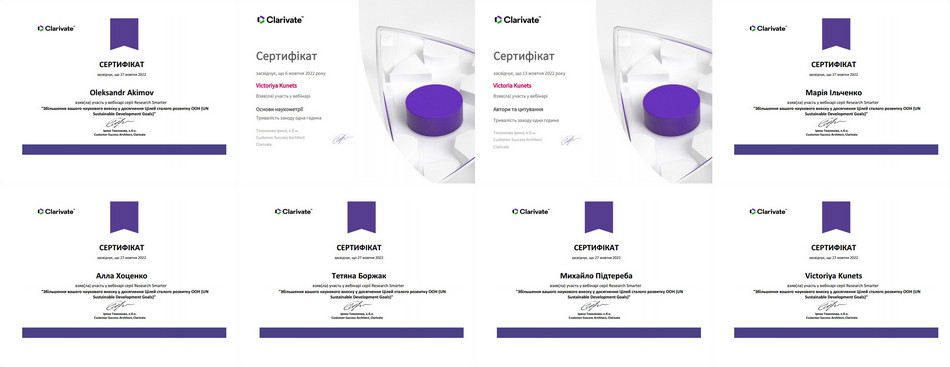
Yes, Clarivate webinars on the topic of "Fundamentals of Scientometrics" (October 6, 2022) were meaningful and useful for scientists. A historical excursion was listened to, terminology, data, indicators and their correct and incorrect application were revealed. The founders of scientific and professional publications needed a lecture on the topic "How the impact factor and its variations are calculated and what affects it, Journal Citation Indicator, quartile, h-index, CNCI, beamplots, and how they are useful to a scientist in everyday practice."
The webinar, which took place on October 13, 2022, on the topic: "Authors and citations" , considered the following issues: what indicators, absolute and normalized metrics are used to assess the impact of a scientist; what are highly cited works and highly cited scientists. How are Citation Laureates™ determined, how are they related to the Nobel Prize. The practical block of the webinar "How to work with an author's profile in Web of Science. Where did Publons go?" turned out to be extremely necessary for the user. How to combine several collections of documents of the same author.
There was a webinar organized by Elsevier «Functional capabilities of the Scopus database - how to use its potential» (19.10.22) We learned what the Scopus abstract database is and its content, what functionalities it offers and how to search for literature and profiles (researcher/institution).
The final stage of the webinar took place on October 27, 2022. on the topic: «ResearchSmarter: Increasing your scientific contribution to achieving the UN Sustainable Development Goals (UNSustainableDevelopmentGoals)»
In this webinar, we learned how Web of Science and InCites Clarivate tools can help you:
• explore the causes of today's scientific breakthroughs;
• find the basis for further discoveries across disciplines;
• quickly assess the current research environment.
With the right data and tools, you can improve your research, orienting it towards achieving the Sustainable Development Goals development.